Aluminum Carry-On
An aluminum carry-on is a cabin-sized hard case with a metal shell, built to ride in the overhead bin rather than the hold. It is the bag that gets handled every single trip: lifted into bins, dragged through terminals, pushed into airline sizers, and now and then gate-checked into the cargo hold at the last minute. A rigid metal shell is the most durable answer to that kind of daily use.
What matters when buying aluminum carry on luggage is different from buying a checked case. Sizing against the airlines you actually fly comes first. Then the closure, because a frame with latches behaves differently from a zipper at security and in a crowded bin. Then weight, wheels, and whether the parts that wear can be repaired.
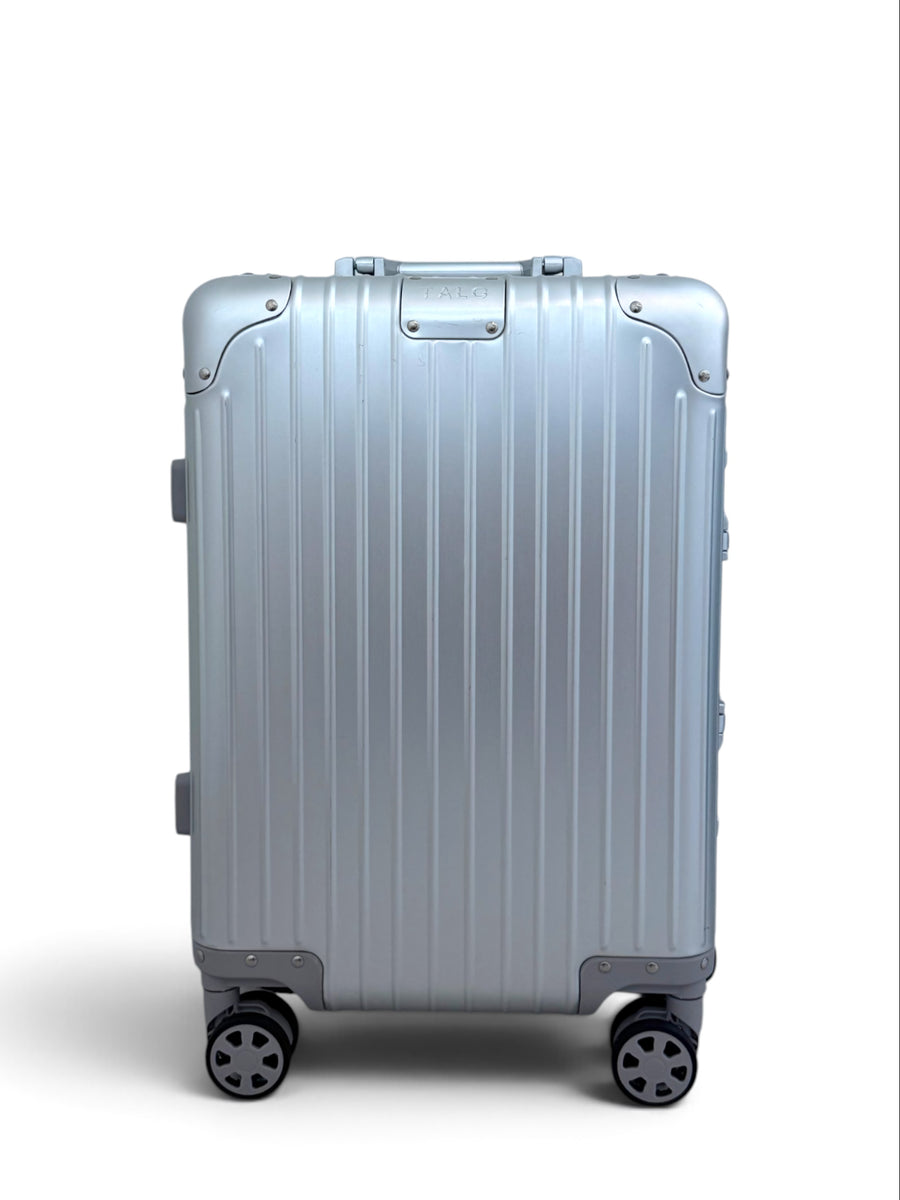
TALO makes one case and it is exactly this: The Cabin, an aluminum carry-on suitcase at $379, built to standard cabin sizing for major US airlines. What follows is what to check on any aluminum carry-on, and how The Cabin measures against that list.
-
 Carry-On Luggage
The Cabin
$379Ribbed anodized aluminum, TSA frame latches, no zippers, silent spinner wheels. Engraved plate. Lifetime service.
View The Cabin
On this page
What to look for in an aluminum carry-on
Sizing against the airlines you fly
The standard US domestic carry-on limit is 22 x 14 x 9 inches including wheels and handles, used by American, Delta, United, Alaska, JetBlue, and Hawaiian. Southwest and Frontier allow 24 x 16 x 10, Spirit 22 x 18 x 10. A rigid shell has no give, so an aluminum case that is over by half an inch stays over in the sizer, where a soft bag would squash through. Allowances change, and the airline's own page is the final word. Our carry-on size guide keeps the numbers in one place.
Frame latches instead of a zipper
This is the biggest difference in the category. An aluminum carry-on closes by clamping two rigid halves onto a frame with latches. There are no zipper teeth to split when the bag is overpacked and no coil to open with a pen. The trade is that a latched case cannot be forced closed. It holds what it holds. For most travelers that turns out to be a feature. Luggage without zippers goes deeper.
TSA-recognized locks built into the latches
TSA locks are not required by law, and they matter most on checked bags. But a carry-on gets gate-checked on full flights, so integrated TSA-recognized latch locks, marked with the Travel Sentry red diamond, let an agent open the case without cutting anything off. Zipper-lock cases rely on a padlock through two pulls, which is easier to lose and easier to defeat.
Weight, and whether your airlines weigh
Aluminum weighs more than polycarbonate. On US domestic flights that is mostly theoretical, because most majors publish no carry-on weight limit. Fly international carriers that cap cabin bags at 7 to 12 kg (15 to 26 lb) and the extra shell weight comes straight out of your packing allowance. Be honest about your routes. Carry-on weight limits lists who weighs and who does not.
Wheels and a handle that survive the terminal
A carry-on rolls farther than any checked bag, across terminals, jet bridges, and hotel lobbies. Four spinner wheels on sealed bearings are quiet and effortless on smooth floors, and they should mount with screws so they can be replaced. The telescoping handle should be metal, lock at more than one height, and have no play when extended. Handle wobble is the first sign of a case that was built to a price.
Service for the parts that wear
The shell of an aluminum carry-on will outlast its wheels, latches, and trolley. The warranty should cover exactly those parts, and it should say repair rather than replace, because a replacement policy usually ends the moment the model is discontinued.
Aluminum carry-on against the alternatives
| Situation | Aluminum | Polycarbonate | Soft-shell |
|---|---|---|---|
| In the sizer | No give, fits or does not | Slight flex | Squashes to fit |
| Under a stacked bin | Holds shape | Bows, springs back | Contents take the load |
| Closure | Frame latches | Mostly zipper | Zipper |
| Weight | Heaviest | Light | Lightest |
| Gate-checked | Dents, keeps working | Scuffs, may crack | Tears, soaks through |
| Price band | $300 to well over $1,000 | $150 to $600 | $80 to $500 |
The honest summary: polycarbonate wins on weight and price, soft-shell wins on squeezing into a full bin, and aluminum wins on everything that happens after the first year. For the broader shell comparison, read aluminum vs polycarbonate luggage.
How the Cabin fits
The Cabin is built to standard cabin sizing for major US airlines, so it is designed for the overhead bin on the carriers most people fly. The shell is ribbed anodized aluminum. It closes on TSA-approved frame latches with no zippers anywhere, which answers both the closure and the lock question above in one piece of hardware. Four silent spinner wheels and a machined aluminum telescoping handle take care of the terminal miles. The only branding is an engraved aluminum plate, 48 x 13 mm, riveted to the shell.
It is $379, with free tracked shipping in the contiguous US and 14-day returns. Lifetime service covers wheels, latches, handles, and the telescoping trolley, repaired rather than replaced for the life of the case. Sizing rules change by airline, so check your carrier before flying, and see The Cabin for the product page.
Looking wider? Carry-on luggage covers every cabin option, and aluminum luggage covers the material at every size.
Common questions
Is aluminum carry on luggage allowed in the cabin?
Yes. Airlines regulate size and sometimes weight, not material. An aluminum carry-on that fits the airline's published dimensions goes in the overhead bin like any other bag. Rigid cases cannot be squeezed, so measure against the airlines you fly, including wheels and handles.
Will an aluminum carry-on fit in the sizer?
Only if its outside dimensions, wheels and handle included, are within the airline's limit. There is no squash factor with metal. Buy a case built to the 22 x 14 x 9 inch standard used by the major US carriers and check the sizer rules of any budget carrier separately.
Is an aluminum carry-on too heavy?
For US domestic flights, no, since most major carriers do not weigh carry-ons. For international airlines with 7 to 12 kg cabin limits, the shell weight leaves less room for contents, and a lighter polycarbonate case may suit those routes better.
Do aluminum carry-ons have TSA locks?
Good ones build TSA-recognized locks into the frame latches. That lets an agent open a gate-checked case without cutting anything. TSA locks are not legally required, and they matter most on checked bags, but integrated latch locks are more secure than a padlock through zipper pulls.
What happens when an aluminum carry-on gets gate-checked?
It may pick up a dent or scuff from the hold. The shell stays rigid and the latches keep working, because they mount to the frame rather than the panel. That is a better outcome than a cracked plastic shell or a torn soft bag.


