Aluminum Luggage
Aluminum luggage is hard-shell luggage made from sheet metal instead of molded plastic. The shell is rigid rather than springy, it closes on a frame with latches instead of a zipper, and it ages by collecting dents and scuffs instead of cracks. An aluminum suitcase costs more and weighs more than a polycarbonate case of the same size. It is also the only kind of case that is routinely still in service after twenty years.
When you buy one, five details decide whether you are getting a case that improves with age or one that only looks the part: the anodizing, the ribbing, how the frame is joined to the shell, the latches, and whether the wheels can be replaced. Everything else is finish and branding.
TALO makes one aluminum case, The Cabin, at $379. It is carry-on sized, so if you want a checked aluminum trunk this is not your page. If you want a single cabin case that closes on TSA-approved frame latches, rolls on silent spinners, and gets repaired rather than replaced when the moving parts wear, it is right below.
-
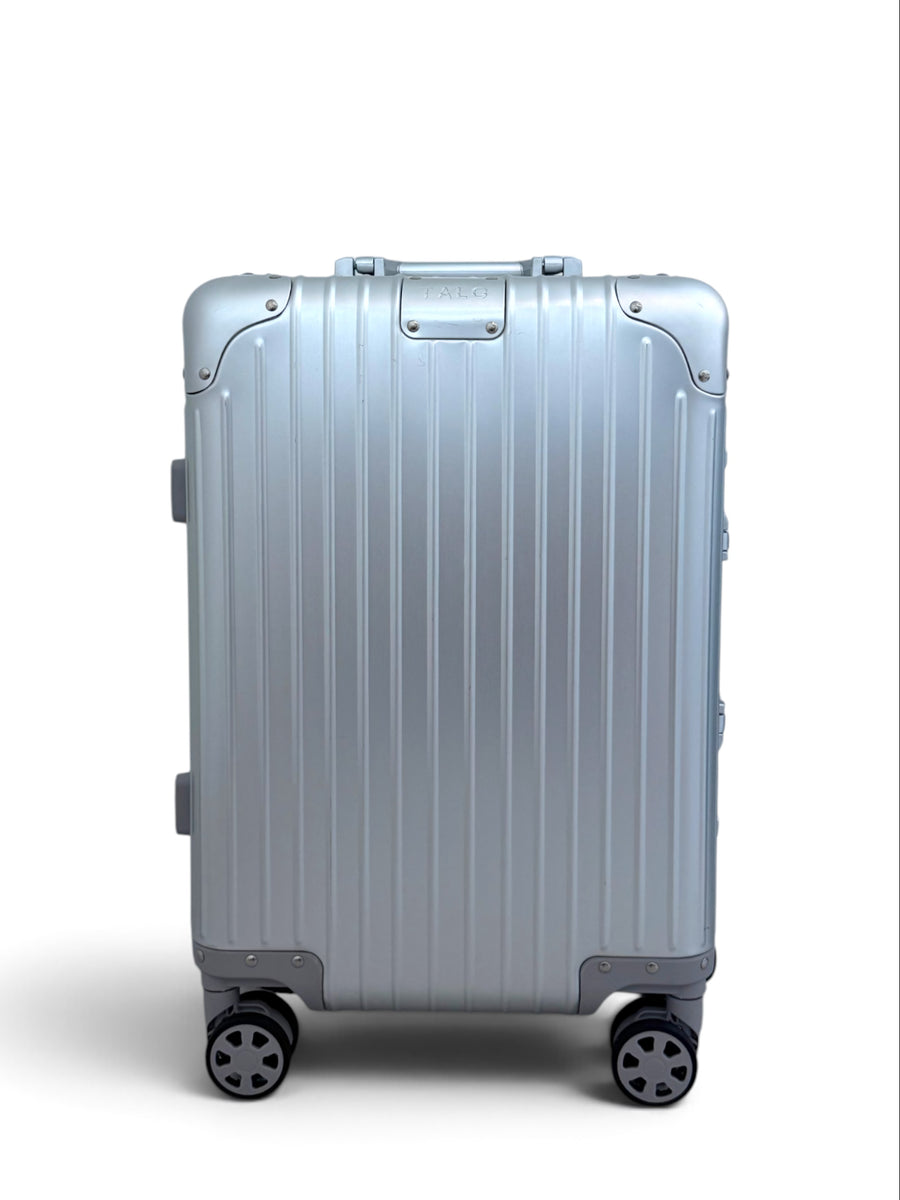 Carry-On Luggage
The Cabin
$379Ribbed anodized aluminum, TSA frame latches, no zippers, silent spinner wheels. Engraved plate. Lifetime service.
View The Cabin
On this page
Why aluminum, and what it costs you
Metal luggage earns its price on rigidity. A polycarbonate shell protects by flexing and springing back. An aluminum shell protects by not moving at all. That is why the closure can be a rigid frame with latches: two halves meet on a machined frame and a gasket, with no zipper teeth to split under pressure or pry open with a pen. Rigidity also means the case carries a stack of other bags without bowing into your laptop.
The second reason is time. Aluminum does not fatigue, because it does not flex. It dents, holds the dent, and keeps working. And because the shell outlives the moving parts, the wheels, latches, and handle on a good aluminum case are built to be serviced rather than thrown away with the case.
Now the honest downsides.
- Weight. A few pounds heavier than the same size in polycarbonate. Most US majors publish no carry-on weight limit, so it rarely matters domestically. On international carriers that cap cabin bags at 7 to 12 kg, it eats into what you can pack.
- Price. Real aluminum starts in the hundreds, and the best known makers charge well over $1,000 for a carry-on.
- Dents. The first one stings. If you want a case that looks new for years, aluminum is the wrong material. Does aluminum luggage dent explains what a dent does and does not affect.
What to look for in aluminum luggage
Anodizing, not paint
Anodizing grows a hard oxide layer into the surface of the metal, so the color is part of the aluminum rather than sitting on top of it. Painted or powder-coated shells chip at the corners and show bright metal within a few trips. Silver aluminum luggage is the classic look because bare anodized aluminum is silver. Darker shells are anodized with dye, not coated. If the finish is a coating, keep looking.
Ribs that run the length of the shell
The grooves on a classic aluminum case are structural. They stiffen thin sheet the way corrugation stiffens cardboard, so the panel holds its shape under load. Deep, evenly spaced ribs are a sign of proper tooling. Shallow decorative lines pressed into a flat panel are not.
A riveted frame
The frame is what the latches, hinges, and gasket attach to, and it holds the two halves square after a drop. Look for a frame riveted to the shell along its full perimeter. Glued or spot-fixed frames work loose, and once the frame moves, the latches stop seating.
Latch quality
Frame latches should snap shut with a definite click and release in one motion. Cheap latches use thin stamped steel that bends, or plastic housings that crack in the cold. TSA-recognized latch locks, marked with the Travel Sentry red diamond, let an agent open the case without cutting anything.
Wheel bearings and replaceability
Wheels are the first part to wear on any case. Good spinners run on sealed ball bearings and mount with screws so they can be swapped. Riveted or glued wheels turn a small repair into a new suitcase. This matters more on aluminum, because the shell will outlast several sets of wheels.
A warranty that means repair
Many lifetime policies exclude wheels, handles, and anything an airline touched, which is nearly everything. A useful warranty names the moving parts and commits to fixing them. Luggage lifetime warranties compares the common fine print.
Aluminum against the other shells
| Shell | Impact behavior | Closure | Typical carry-on price |
|---|---|---|---|
| Aluminum | Dents, stays rigid | Frame latches | $300 to well over $1,000 |
| Polycarbonate | Flexes, cracks with age | Zipper, some frames | $150 to $600 |
| ABS | Flexes less, cracks sooner | Zipper | $50 to $150 |
| Soft-shell | Absorbs, no crush protection | Zipper | $80 to $500 |
Price bands in aluminum run wide. Under $300 usually means thin sheet, coated rather than anodized, with riveted wheels. The $300 to $600 band is where properly anodized, ribbed, frame-latched cases with serviceable parts live. Above $1,000 you are paying for the heritage names, Rimowa and Zero Halliburton among them, and for boutique finishes. For a side-by-side with the plastic alternative, read aluminum vs polycarbonate luggage. If you are weighing the big names, Rimowa alternatives is the honest read.
How the Cabin fits
The Cabin is TALO's answer to the checklist above. The shell is ribbed anodized aluminum. It closes on TSA-approved frame latches, with no zippers anywhere on the case. It rolls on four silent spinner wheels and extends on a machined aluminum telescoping handle. The only branding is an engraved aluminum plate, 48 x 13 mm, riveted to the shell. It is built to standard cabin sizing for major US airlines.
It costs $379, with free tracked shipping in the contiguous US and 14-day returns. Lifetime service covers the parts that wear: wheels, latches, handles, and the telescoping trolley are repaired, not replaced, for the life of the case. See The Cabin.
Shopping cabin size only? Aluminum carry-on narrows it down. Hard-shell luggage widens it to every rigid option.
Common questions
Is aluminum luggage worth it?
If you fly often and plan to keep one case for a decade or more, yes. The shell does not fatigue, the moving parts can be serviced, and the case holds value secondhand. If you fly twice a year or care most about weight, a good polycarbonate case is the smarter buy.
Is aluminum luggage heavier than polycarbonate?
Yes, usually by a few pounds at carry-on size. That is rarely a problem on US domestic flights, where most majors do not weigh cabin bags. On international carriers with 7 to 12 kg cabin limits, plan your packing around it. Allowances change, so check the airline's site.
Does aluminum luggage dent easily?
It shows impact sooner than plastic, because it deforms instead of flexing back. Ordinary dents are cosmetic and do not affect the latches, wheels, or seal. A crease at a corner or a latch that stops seating is structural and worth a repair.
Is aluminium luggage the same as aluminum luggage?
Yes. Aluminium is the British and international spelling of the same metal. Searches for aluminium luggage and aluminum luggage point to the same category of case.


