Carry-On Luggage
Carry-on luggage is any bag that rides in the cabin with you instead of the hold. On most major US airlines that means a case no larger than 22 x 14 x 9 in, wheels and handles included, that fits the sizer at the gate and the overhead bin on board. It is the most-used piece of luggage most people own, because a good carry-on handles the large majority of trips without bag fees, baggage claim, or the risk of a lost bag.
When you buy a carry-on suitcase, three things matter more than anything else: it clears the size rule of the airline you fly, it closes securely and stays closed, and its wheels and handle hold up to daily use. Everything else is preference.
TALO makes one carry-on bag. The Cabin is a ribbed anodized aluminum case with TSA-approved frame latches instead of zippers, built to standard cabin sizing for major US airlines, at $379, with lifetime service on the parts that wear. The case is below, and the rest of this page covers how to judge it against everything else.
-
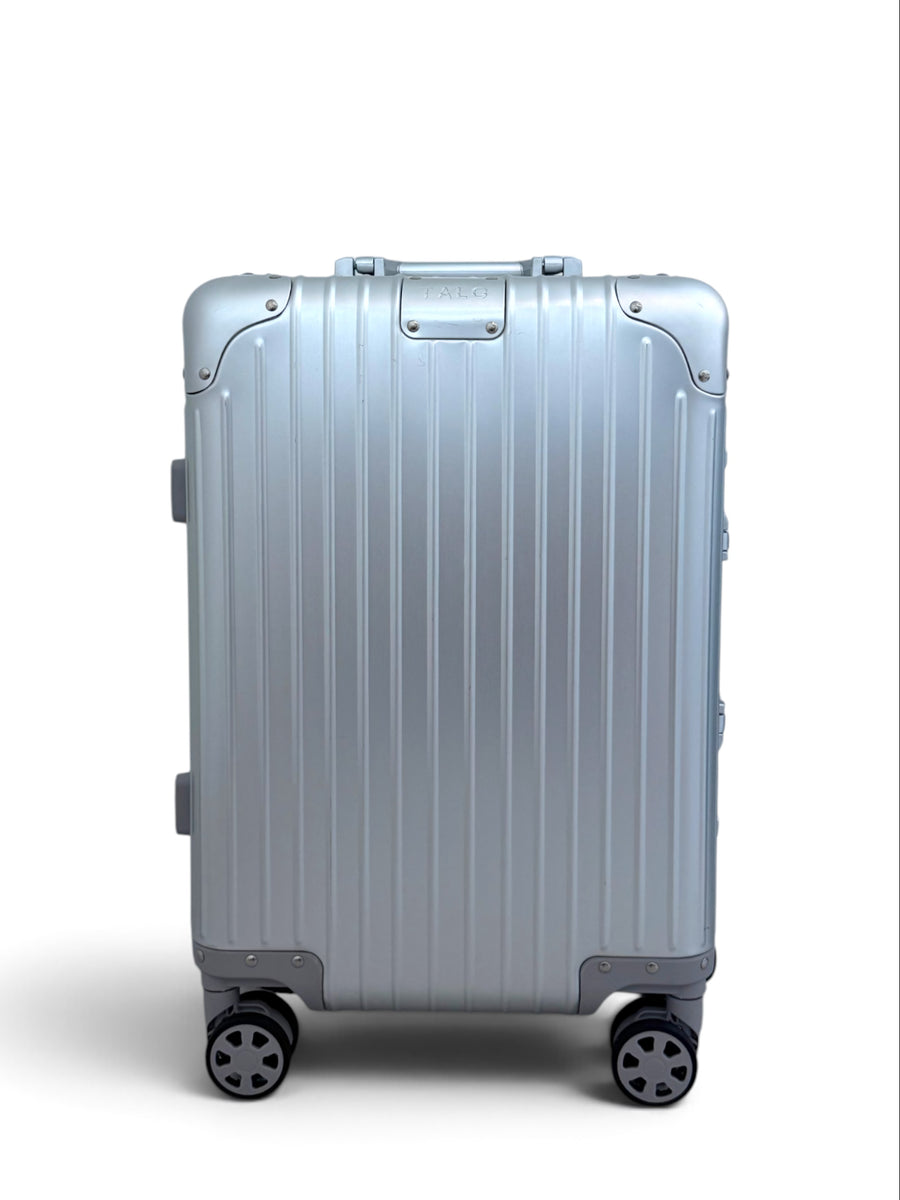 Carry-On Luggage
The Cabin
$379Ribbed anodized aluminum, TSA frame latches, no zippers, silent spinner wheels. Engraved plate. Lifetime service.
View The Cabin
On this page
What counts as a carry-on
The standard for American, Delta, United, Alaska, JetBlue, and Hawaiian is 22 x 14 x 9 in (56 x 36 x 23 cm), measured with wheels and handles. A few airlines run larger: Southwest and Frontier allow 24 x 16 x 10 in, and Spirit allows 22 x 18 x 10 in. Those bigger limits only help if you never fly anyone else, so most people buy to the 22 x 14 x 9 standard. Internationally, the IATA guideline is 115 cm, or 45 linear inches, total. Allowances change, and the airline's own site is always the final word.
A carry-on is separate from the personal item, the smaller bag that goes under the seat in front of you. Basic economy fares on some airlines allow only the personal item, so check the fare, not just the airline. Our carry-on size guide has every major airline in one table and explains how to measure.
Carry-on size limits at a glance
| Airline | Carry-on limit | Notes |
|---|---|---|
| American, Delta, United, Alaska, JetBlue, Hawaiian | 22 x 14 x 9 in | Wheels and handles included |
| Southwest | 24 x 16 x 10 in | Larger than the standard |
| Frontier | 24 x 16 x 10 in | Larger than the standard |
| Spirit | 22 x 18 x 10 in | Wider than the standard |
| IATA guideline | 115 cm / 45 linear in | Common reference abroad |
Limits change. Check the airline before you fly.
What to look for in carry-on luggage
Size that clears the sizer
Measure the outside of the case with wheels and handle, not the interior the brand advertises. A case that is 22 in tall on the body and 23 in with wheels is over the rule, and gate agents measure the whole thing.
Hard shell or soft shell
Soft shell carry-ons compress into tight bins and offer outside pockets. Hard shells in polycarbonate are light and protective but close with zippers and get brittle with age. Aluminum is heavier, costs more, dents rather than cracks, and is the only common shell that closes with a rigid latched frame. Hard shell versus soft shell has the full comparison.
Closure
Zippers fail by bursting when overpacked and can be opened with a pen. Frame latches close only when the contents fit and cannot be split. For a case that lives in overhead bins and on airport floors, this is the difference between a bag that lasts and a bag that does not.
Wheels and handle
Four-wheel spinners roll upright beside you and down the aircraft aisle. Two-wheel cases pull behind you and handle rough ground better. Either way, the wheels and the telescoping handle are the parts that fail first, so look at how they are built and whether the brand repairs them.
Weight, at home and abroad
Most US majors publish no carry-on weight limit domestically. International carriers commonly cap the cabin bag at 7 to 12 kg (15 to 26 lb), including the case itself. A heavy case eats into that allowance, so if you fly abroad often, know the empty weight before you buy. Carry-on weight limits lists the carriers that weigh.
Warranty and repair
Defect-only lifetime warranties exclude the wear that actually happens. Look for a program that repairs wheels, latches, and handles for the life of the case, and read whether covered repairs cost anything.
Why one good carry-on beats a set
A luggage set bundles a carry-on with one or two checked cases. The carry-on gets used on nearly every trip. The checked cases get used a few times a year, take up closet space, and pull the build quality of the whole set down to hit a bundle price. Buying one carry-on built to last, then adding a checked bag only if a specific trip demands it, costs less over time and travels lighter. One case versus a luggage set runs the math.
How the Cabin fits
The Cabin is TALO's only case, and it is built for exactly this category. The shell is ribbed anodized aluminum. It closes with TSA-approved frame latches, no zippers anywhere. It rolls on silent four-wheel spinners and extends on a machined aluminum telescoping handle. The only branding is an engraved aluminum plate, 48 x 13 mm, riveted to the shell. It is built to standard cabin sizing for major US airlines.
It costs $379, with free tracked shipping in the contiguous US and 14-day returns. Wheels, latches, handles, and the telescoping trolley are repaired, not replaced, for the life of the case under lifetime service. If you want the lightest possible carry-on or the cheapest, a polycarbonate case wins on both and we say so in our guides. If you want a carry-on suitcase you buy once, see The Cabin. For the material angle, see aluminum carry-on, or start from the luggage hub.
Common questions
What size is carry-on luggage?
The common US standard is 22 x 14 x 9 in including wheels and handles, used by American, Delta, United, Alaska, JetBlue, and Hawaiian. Southwest and Frontier allow 24 x 16 x 10 in and Spirit allows 22 x 18 x 10 in. Allowances change, so check the airline's site before you fly.
Is a carry-on suitcase the same as a carry-on bag?
Yes, in airline terms. The airline counts one carry-on, whether it is a wheeled suitcase, a duffel, or a backpack, as long as it fits the size limit. A separate, smaller personal item goes under the seat.
Do carry-ons have a weight limit?
Most US majors do not publish one for domestic flights. Many international carriers cap the cabin bag at 7 to 12 kg (15 to 26 lb), case included, and some weigh it at check-in or the gate.
Is hard shell or soft shell better for a carry-on?
Hard shell protects better and cleans easier. Soft shell squeezes into full bins and has outside pockets. Among hard shells, aluminum trades a little weight and a higher price for a latched frame and a case that can be repaired instead of replaced.


