Spinner Luggage
Spinner luggage is any suitcase that rolls on four wheels, each turning a full 360 degrees, so the case glides upright beside you instead of tilting behind you on two. On a smooth airport floor a good spinner moves with a fingertip. On cobbles, gravel, and curbs, a two-wheeler with big recessed wheels still wins, and no honest spinner page should pretend otherwise.
What makes a spinner good is almost entirely in the wheels: the bearings, the diameter, whether each corner has one wheel or two, and above all whether they can be replaced. Wheels are the first part of any suitcase to fail. A four wheel suitcase with unreplaceable wheels has a lifespan, and it is not long.
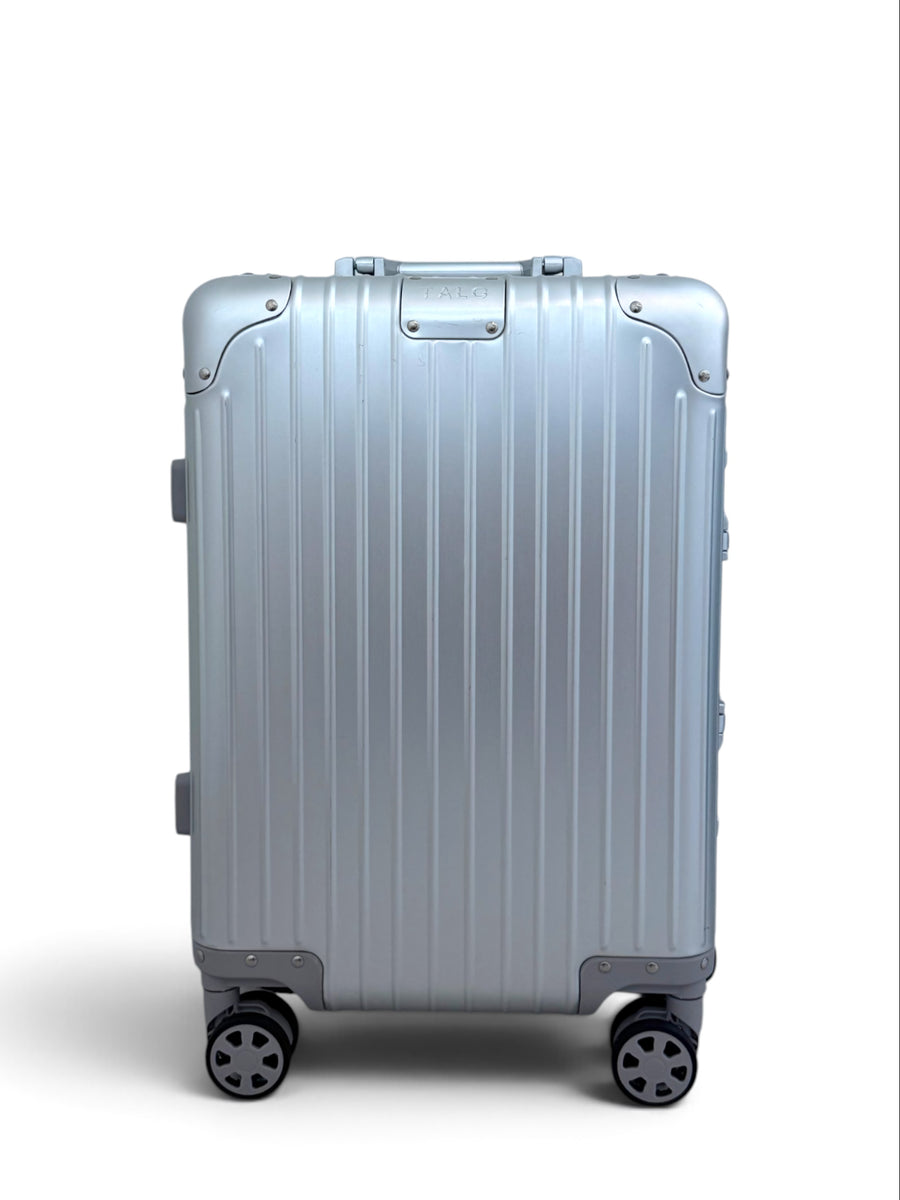
TALO makes one spinner, The Cabin, an aluminum carry-on at $379 with four silent spinner wheels that are serviced for the life of the case. If you want carry on luggage with wheels you never have to think about, that is the pitch, and the checklist below is how to judge it against anything else.
-
 Carry-On Luggage
The Cabin
$379Ribbed anodized aluminum, TSA frame latches, no zippers, silent spinner wheels. Engraved plate. Lifetime service.
View The Cabin
On this page
Spinner vs two-wheel, honestly
Four wheels win indoors. The case stays upright, puts no weight on your arm, and turns in its own footprint, which matters in a jet bridge queue or a narrow aisle. Two wheels win outdoors. Two-wheel cases use larger, partly recessed wheels that roll over cracks and cobbles a small caster stalls on, and they carry better up a curb. Spinners also roll away on a sloped train platform unless you lay them down or hold the handle, which is why some rail travelers stick with two.
The trade-off is real, but most travelers spend their rolling miles on terminal floors, hotel corridors, and sidewalks, where the spinner is the better tool. Spinner vs two-wheel luggage walks through the full comparison.
What to look for in spinner luggage
Sealed ball bearings
The difference between a spinner that glides and one that grinds is the bearing. Cheap wheels spin on a plastic bushing over a steel axle, which is fine on day one and noisy by month six. Sealed ball bearings keep grit out and keep rolling resistance low. Spin a wheel by hand: it should keep turning silently for a few seconds.
Wheel diameter
Bigger wheels roll over bigger gaps. Carry-on spinners usually run wheels around 50 to 60 mm, and the larger end of that range noticeably improves the ride over expansion joints and rough sidewalks. Very small wheels keep the case compact for the sizer at the expense of everything else.
Dual versus single wheels
Double wheels at each corner spread the load across two contact patches and track straighter, so the case is less likely to wander. They are quieter on smooth floors and more stable when the case is loaded unevenly. Single wheels are lighter and cheaper. For a case you roll every trip, dual wheels are worth the small weight penalty.
Replaceable wheels
This is the spec that outranks all the others. A wheel that mounts with screws can be swapped in ten minutes. A wheel that is riveted through the shell can only be fixed by drilling, which usually means the case is finished. Ask the maker directly whether wheels are replaceable and whether they will do the work. Luggage wheel repair explains what is fixable and what is not.
Housings that protect the wheel
On a hard case the wheels are the parts sticking out, so they take the first hit from every belt and bin. A recessed housing or a reinforced mounting zone keeps a corner drop from shearing an axle. Wheels that hang fully exposed below the shell look sleek and break first.
A handle that matches the wheels
Spinners are steered from the handle, so play in the trolley shows up as a case that veers. Look for a metal telescoping handle that locks solidly at each height with no wobble side to side. Suitcase handle stuck covers what goes wrong with the cheap ones.
Spinner against two-wheel, surface by surface
| Surface | Four-wheel spinner | Two-wheel |
|---|---|---|
| Terminal floor | Glides upright, no arm load | Tilted, weight on wrist |
| Narrow aisle or queue | Turns in place | Needs room to swing |
| Cobbles and gravel | Small wheels stall | Big wheels roll through |
| Curbs and stairs | Tilt onto two or lift | Bumps up on two |
| Sloped platform | Rolls away unattended | Stays put |
| Wear points | Four small wheels | Two larger wheels |
Most spinners can be tilted back onto two wheels for a curb or a rough patch, so the practical gap is smaller than the table suggests. It is not zero. For a broader take on choosing a case, see how to choose carry-on luggage.
How the Cabin fits
The Cabin rolls on four silent spinner wheels and steers from a machined aluminum telescoping handle. The shell is ribbed anodized aluminum, so the wheel mounts sit in a rigid structure rather than a flexing plastic panel, and it closes on TSA-approved frame latches with no zippers. It is built to standard cabin sizing for major US airlines, and it carries an engraved aluminum plate, 48 x 13 mm, riveted to the shell, as its only branding.
The part that matters most on this page: the wheels are covered by lifetime service. Wheels, latches, handles, and the telescoping trolley are repaired, not replaced, for the life of the case. A worn wheel after a few hundred terminal miles is a service ticket rather than the end of the suitcase. It costs $379, with free tracked shipping in the contiguous US and 14-day returns. See The Cabin.
For the full cabin category, browse carry-on luggage, or stay with rigid cases in hard-shell luggage.
Common questions
Is spinner luggage better than two-wheel?
Indoors, yes. A spinner moves upright with no weight on your arm and turns in place in queues and aisles. Outdoors on cobbles, gravel, and curbs, a two-wheeler with larger recessed wheels rolls better. Most travelers spend more miles on smooth floors, which is why spinners dominate the carry-on category.
Do spinner wheels break easily?
Cheap ones do, because they run on plastic bushings and mount with rivets that cannot be serviced. Quality spinners use sealed bearings and screw-mounted wheels, so a worn wheel is a quick swap. Wheel failure is the most common way any suitcase dies, so buy for replaceability first.
Are four wheel suitcases allowed as carry-on?
Yes, as long as the case fits the airline's size limit with the wheels included. Wheels count toward the published dimensions on every major US carrier, so a spinner's outside measurement is the number that matters. Allowances change, and the airline's site is the final word.
Why do some spinners roll away on their own?
Four free-turning casters have no resistance, so any slope moves the case. On a train platform or a ramp, lay the case on its side, lean it against something, or keep a hand on the handle. Some spinners include a wheel brake, but most do not.
Can spinner wheels be replaced?
On screw-mounted wheels, yes, often in minutes with a matching part. On riveted wheels it takes drilling and a compatible housing, which is rarely worth it. Check before buying whether the maker offers wheel replacement or repair.


